⌕
THE SOURCE FILE
One image.
More than one question.
Separate what you can see from what the archive can confirm.
Five ways to investigate history. Follow evidence, explore choices under pressure, decode stories and places, and practise checking what appears in your feed.
Open a case, follow a clue, compare records and build your own evidence-based explanation. You do not need to know everything before you start — curiosity is the first tool.
Separate what you can see from what the archive can confirm.
Explore historical context before drawing conclusions about people.
Use source-checking skills when a dramatic claim appears in your feed.
Short interactive stops. Explore one now, then go deeper in the activities below.
The Holocaust was not one event that happened all at once. Move through key stages of an evolving process.
After Adolf Hitler became chancellor on 30 January, the Nazi Party rapidly transformed Germany into a one-party dictatorship. Persecution of Jews began almost immediately.
Based on the USHMM Holocaust timeline ↗. This is a brief overview, not a complete chronology.
CASE 01 / ŁÓDŹ GHETTO · MARCH 1942
A young diarist recorded severe food shortages and daily hunger in the Łódź ghetto. The diary is one person’s record, preserved and published with historical context by a museum.
Which claim is supported by this source?
Explore the USHMM diary records and context ↗.
Not every camp had the same function. What is the most accurate statement?
Read the USHMM overview of Nazi camps ↗.
Historians do not ask only whether a source is “true” or “false”. They ask who made it, why it exists, what it can establish, what it leaves out, and how it fits with other evidence.
Your task: examine three historical source files. For each one, choose the strongest interpretation supported by the evidence.
Carefully adapted source summary — not a quotation
Two laws passed by Nazi Germany stripped Jews of full Reich citizenship and prohibited marriages between Jews and people classified as being of “German or related blood”. The laws made antisemitic racial ideology part of state law. The law text describes what the regime authorised and prohibited; by itself, it does not document every local act of enforcement or every person’s experience.
Carefully adapted source summary — not a quotation
An anonymous girl diarist in the Łódź ghetto recorded severe shortages of food and the daily struggle to find something to eat. In a separate entry the next day, she described how a sunny day briefly lifted her mood, even while the ghetto fence made her feel trapped. These entries give evidence of one young person’s experience and of the coexistence of hardship, feeling, and ordinary daily observation.
“When it’s so cold, even my heart is heavy. There is nothing to cook today; …”
Carefully adapted source summary — not a quotation
A USHMM collection entry identifies a photograph showing Jewish children being deported from the Łódź ghetto during the German authorities’ September 1942 roundup. Its caption supplies a place, date, historical event, and collection credit. The image is evidence, but the caption and related records are essential to identify the event responsibly; a photograph alone cannot tell us every person’s name, thoughts, or later fate.
Start with what is visible. Then use the archive caption to separate observation from documented context and from claims the evidence cannot establish. The image is a historical document, not an invitation to guess what the people pictured were thinking or feeling.
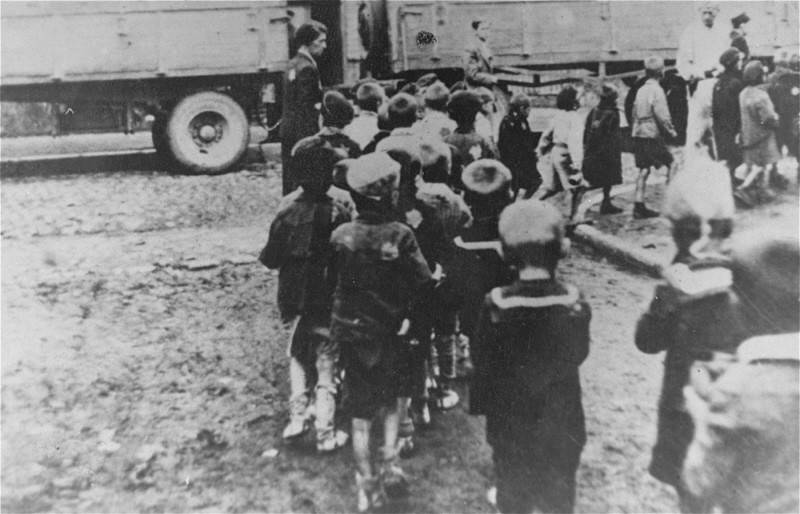
Take 20 seconds to notice details. Do not infer names, thoughts, feelings, or later fates from appearance alone.
The USHMM record identifies the photograph as showing the deportation of Jewish children from the Łódź ghetto during the “Gehsperre” action in September 1942. German authorities rounded up about 15,000 Jews during this operation, targeting the sick, older people, and children under ten, and deported them to the Chełmno killing center. The caption provides historical context that cannot all be read from the image alone.
For each claim, choose the category that best describes it. Think about the source named in the question: sometimes the photograph supports a different kind of claim than the archive record does.
Complete the three-part claim: “I can observe… The archive tells me… I cannot conclude from this photograph alone…”
Choose one source above. Complete this sentence in your own words: “This source helps us understand ______ because ______. However, it cannot tell us ______.”
There is no single model sentence. Strong answers make a clear claim, use evidence precisely, and state a real limitation.
Open the original catalogue records and compare what each institution preserves. These examples document different places, events, people and administrative processes. Read each record's caption and provenance before interpreting an image or document.
POLIN Collections documents the former ghetto site in Łódź through contemporary photographic documentation and provides historical context. The site photographs were made in 2017, not during the war.
Open POLIN: Ghetto Litzmannstadt — site documentation ↗
Compare this with a wartime USHMM photograph of the deportation of Jewish children from the Łódź ghetto in September 1942.
Open USHMM: Deportation of Jewish children from the Łódź ghetto ↗
USHMM preserves photographs of Jewish residents of Bitola (Monastir) used by Bulgarian occupation authorities to register the population before deportation. Its collections also document deportations from Bulgarian-occupied territories through Lom on the Danube. These deportations concerned occupied territories, not the Jewish population of Bulgaria's pre-war core provinces.
Open USHMM: Jewish Community of Monastir — photographs for registration ↗
Open USHMM: Deportation of Jews by Bulgarian authorities, Lom, March 1943 ↗
USHMM catalogues photographs documenting the Iași pogrom and the deportation of survivors in June–July 1941. A separate Arolsen Archives collection contains 750 Romanian police documents from 1942 — correspondence, notes, protocols, lists, memoranda, statements and a map relating to the deportation of Jews and Roma to Transnistria.
Which statement best describes how these three archival groups should be used in historical inquiry?
Choose one item from each country. Record the creator or holding institution, date, place, source type and what it documents. Then identify one question that the item cannot answer on its own.
This case study asks how we analyse decisions when power is radically unequal. The purpose is not to decide whether people in the ghetto made “good” or “bad” choices from a safe distance. It is to identify who held power, what options were constrained or removed, and whose perspectives are needed to understand an event.
Historical summary based on USHMM research
In early September 1942, German authorities ordered that 20,000 people be deported from the Łódź ghetto, including children, older people, and the sick. The German authorities held the decisive coercive power. Chaim Rumkowski, head of the Jewish Council, announced the demand to the ghetto population on 4 September. During the roundup, German SS and police forces carried out deportations; people who tried to hide or flee faced extreme danger, and more than 500 Jews were murdered during the operation.
The situation was shaped by German occupation, imprisonment, starvation, threats, and the removal of meaningful freedom. The role of the Jewish Council and Rumkowski has been debated, but analysis must begin with the coercive system imposed by the Nazi authorities and the fact that the people targeted were victims of persecution.
In pairs, discuss two questions. Try to support each point with a detail from the case file.
The handbook asks learners to distinguish perpetrators, collaborators, bystanders and rescuers, and to examine the conditions that shaped people's responses. Fear, conformity, prejudice, self-interest, access to information and perceived risk may influence behaviour. Understanding these circumstances is not the same as excusing the consequences.
You are studying a documented case in which a neighbour witnessed persecution but did not intervene. What should you investigate before reaching a conclusion?
Learn to examine a message without being pulled along by its emotional force. First analyse historical propaganda in context; then practise checking claims online. Some techniques can recur across time, but similarities in technique do not make different events historically equivalent.
Historical summary — not a quotation from a propaganda poster
Nazi antisemitism did not consist only of insulting messages or individual prejudice. The regime used propaganda and racial stereotypes while also changing laws, excluding Jews from citizenship and public life, encouraging social exclusion, and using state institutions to enforce persecution. The 1935 Nuremberg Laws are one example of antisemitic ideology being turned into law.
Imagine a post claims that a historical photograph proves a dramatic event, but gives no date, location, photographer, or archive reference. Write down the first three checks you would make before sharing it.
The handbook examines how language can label, stereotype, exclude, persuade, dehumanise or protect. Sort the fictional examples below. They are deliberately neutral training examples and do not reproduce historical slurs.
“A few people missed the deadline because the instructions were unclear.” What kind of statement is this?
Now analyse a verified historical source selected by your teacher: Who created the message? Who was its audience? What emotions might it seek to evoke? Who is presented as “us” and who as “them”? What facts are omitted or distorted? Record the source's title, date, creator and institution before discussing it.
Use a documented testimony, diary or biography as the starting point for a reflective letter. Do not write in the voice of a real victim unless the task is explicitly a clearly labelled creative response, and never invent quotations or claim to know what a person would have wanted.
Choose one prompt:
From memory to action: make your proposal specific, realistic and connected to what you have learned. It might involve researching a local trace, improving the description of a memorial, sharing a verified archive resource, or challenging an unsupported claim responsibly.
Objects and photographs can open a route into an individual story, but they do not explain themselves. Work from observation to questions, then to facts confirmed by a reliable record. This follows the handbook's object-based inquiry lesson.
Choose a documented object or photograph from a museum or archive. Its record should identify provenance and connect it to a named person or clearly described historical context. Do not assume that an unprovenanced suitcase belonged to a particular victim.
You see a worn suitcase in a museum. Its record says it belonged to a named person who was deported in 1944. Which interpretation is best supported?
The handbook asks students to read statistics alongside individual biographies or testimony. The figure of six million Jewish victims describes the scale of the Holocaust; an individual account helps investigate a particular life and experience. Neither type of evidence replaces the other.
Write a 100–150-word label connecting one documented object to its owner or historical context. Include at least two details supported by the source, one limitation, and the exact archive or museum reference. Never invent a quotation or present imaginative writing as testimony.
Survivor testimony is a historical source: personal, situated and shaped by memory. Listen to a short excerpt in the archive, then return to the questions below. You do not need to listen to graphic or distressing material to complete this activity.
The handbook proposes an interdisciplinary study of Pavel Friedmann’s poem “The Butterfly” (1942), written in the context of the Terezín ghetto. Explore how literary images and contrasts can preserve a particular voice, while keeping the historical context and the limits of one poem in view.
Read and investigate: use a teacher-verified edition of the poem and a reliable historical source about Pavel Friedmann and Terezín. Do not reproduce an unverified text or treat a creative interpretation as a historical quotation.
A poem written by a prisoner in a ghetto is used in a lesson about the Holocaust. What is the most careful approach?
Create a visual, sound-based or written response inspired by the poem’s themes. Label it as a contemporary response; do not imitate Friedmann’s voice or present new lines as his words.
Investigate traces of Jewish life in a local community: street names, buildings, cemeteries, maps, photographs, museum collections and oral-history records. A trace raises questions; it does not automatically prove a conclusion.
Use three or four teacher-selected local sources. Record the title, creator or holding institution, date if known, and where it was found. If a date or creator is unknown, write “unknown” rather than guessing.
A historical map shows a building on a street where Jewish residents once lived. What can you responsibly conclude from the map alone?
Memorials communicate through location, names, images, materials, inscriptions and the decisions of those who created them. They also leave things out. Examine a local or museum memorial using these prompts:
Create a proposal for a memorial that is historically grounded and respectful. Identify whom or what it commemorates; the evidence used; the location and reason for choosing it; the words or symbols included; accessibility for different visitors; and one limitation or difficult decision. Do not use suffering as decoration or invent names and personal histories.
Use these resources to explore original records, photographs, diaries, and testimony. Always read the archive caption and historical explanation alongside an item.
Law text, translated excerpts, photographs, and context for antisemitic legislation.
Children’s diaries, historical context, and a photograph caption related to deportations.
Guidance for using documents, photographs, diaries, and survivor testimony in class.
Curated databases of historical documents and first-person accounts.
Architecture, photographs, objects and places can preserve traces of community life. They are “silent witnesses”: they prompt questions, but need to be read alongside documents, memoirs, laws, photographs and verified local history. The handbook’s worked example focuses on the Sofia Synagogue and the history of Bulgarian Jews during the Second World War; adapt the method to a documented local site.
You have one exterior photograph of a synagogue. Which statement is best supported?